The last quarantine of the Apollo program
While Shepard and Mitchell were on the surface, Roosa spent nearly two days alone in orbit — photographing the Moon for future missions and testing whether the Gegenschein phenomenon arose from reflections off particles at the L2 Lagrange point. He carried hundreds of tree seeds, which after returning to Earth grew into so-called “Moon trees,” distributed across the United States a few years later.
Antares lifted off from the Moon on 6 February 1971 and docked with Kitty Hawk on the first attempt — the first time in the Apollo program this happened on the very first orbit. The ship then splashed down in the Pacific on 9 February 1971 at 21:05 UTC, about 1,400 km south of American Samoa, where it was recovered by USS New Orleans.
The Apollo 14 crew was the last in the program required to quarantine — the only one quarantined even before launch, due to concerns about infection following the Apollo 13 complications. They were released from quarantine at the Houston laboratory on 27 February 1971. The mission brought NASA back to the Moon after the Apollo 13 accident and cleared the way for the more ambitious lunar-rover flights that followed.
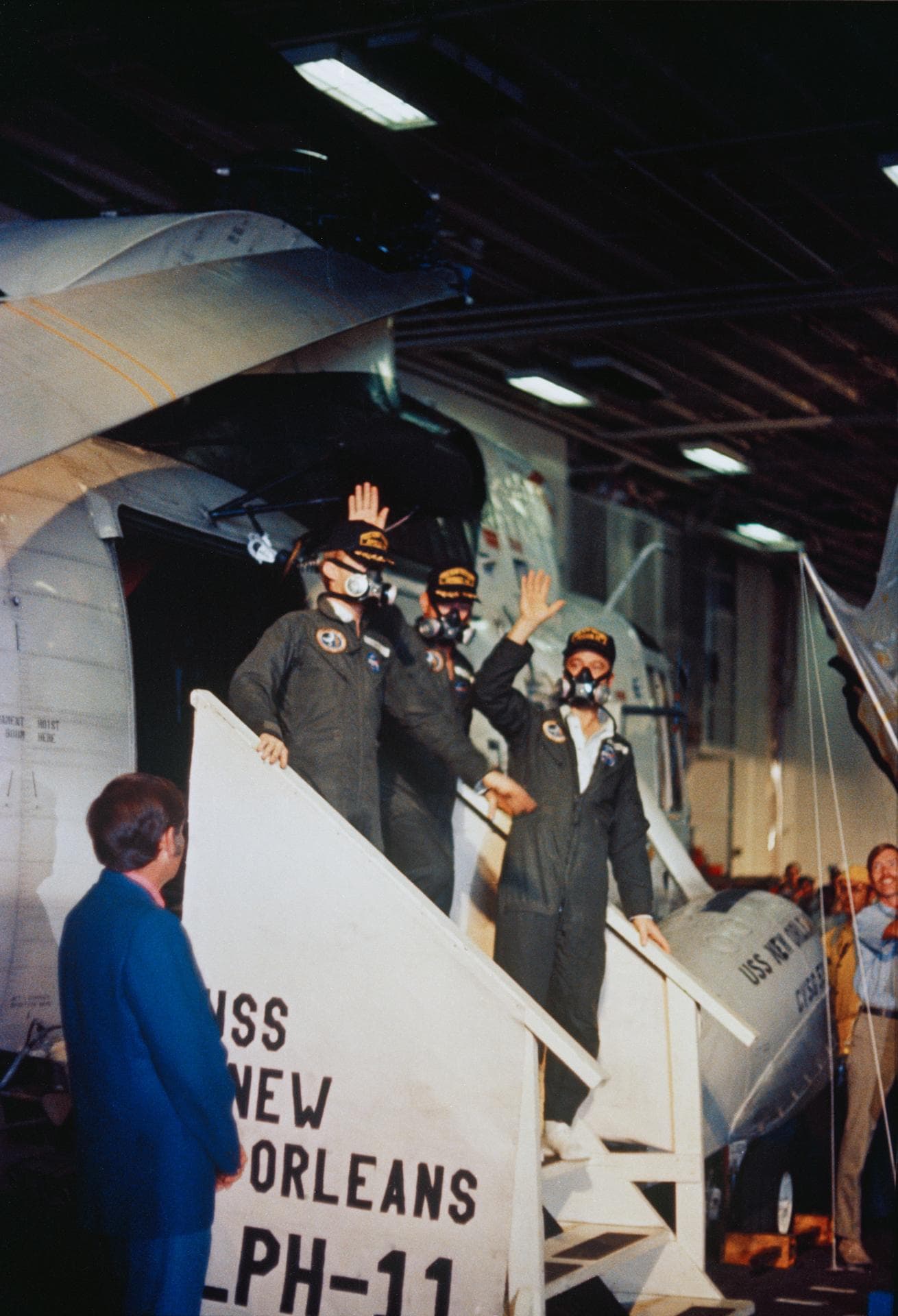 ◉ REÁLNÉ FOTOPosádka v respirátorech na palubě USS New Orleans.